



The benefits of cloud migration go far beyond lower costs and easier scaling. Businesses often gain faster delivery cycles, IT teams focused on growth instead of hardware, more automated governance, practical disaster recovery, and access to AI and analytics without large upfront capital investment of their own.
These advantages can reshape how an organization responds to customers, regulations, and new opportunities. This article covers the familiar benefits, the hidden gains that change competitiveness, and how businesses can realize them through practical planning.
First, it helps to define cloud migration.
What Is Cloud Migration?
Cloud migration is the process of moving data, applications, and IT workloads from on-premises servers to cloud infrastructure operated by a provider such as Microsoft Azure or AWS, where computing, storage, security, and platform services can be consumed on demand instead of maintained entirely in-house.
Businesses migrate to modernize IT, scale on demand, and consume computing more like a utility instead of repeatedly purchasing hardware. Typical buyers are IT directors and CIOs at mid-market and enterprise companies, especially in regulated industries where uptime and compliance have real consequences.
The Business Benefits of Cloud Migration Everyone Already Knows
Most cloud migration discussions begin with the same six advantages. They remain important, but listing them first makes the less obvious business benefits of cloud migration easier to recognize.
| Benefit | What It Means |
| Lower infrastructure costs | Upfront hardware spending shifts toward metered, pay-as-you-go operating expenses. |
| Elastic scalability | Resources can scale up or down as business demand changes. |
| Provider-grade security | Encryption, monitoring, patching, and security capabilities operate at cloud scale. |
| Remote collaboration | Files, applications, and services can be accessed securely from distributed locations. |
| Automatic updates | Managed cloud services reduce the maintenance and upgrade burden on internal IT teams. |
| Business continuity | Cloud platforms provide backup, redundancy, and failover options without requiring equivalent physical infrastructure. |
These benefits are real, but they are no longer a major competitive differentiator because almost every cloud business case starts with them. Organizations that migrated years ago have already captured many of these gains. The more interesting advantages emerge after migration, when cloud capabilities begin changing delivery speed, operating models, recovery planning, compliance practices, and access to new technologies.
Hidden Benefits of Cloud Migration Most Businesses Miss
The less obvious benefits often become visible months after migration, which is why infrastructure-focused planning documents frequently overlook them.
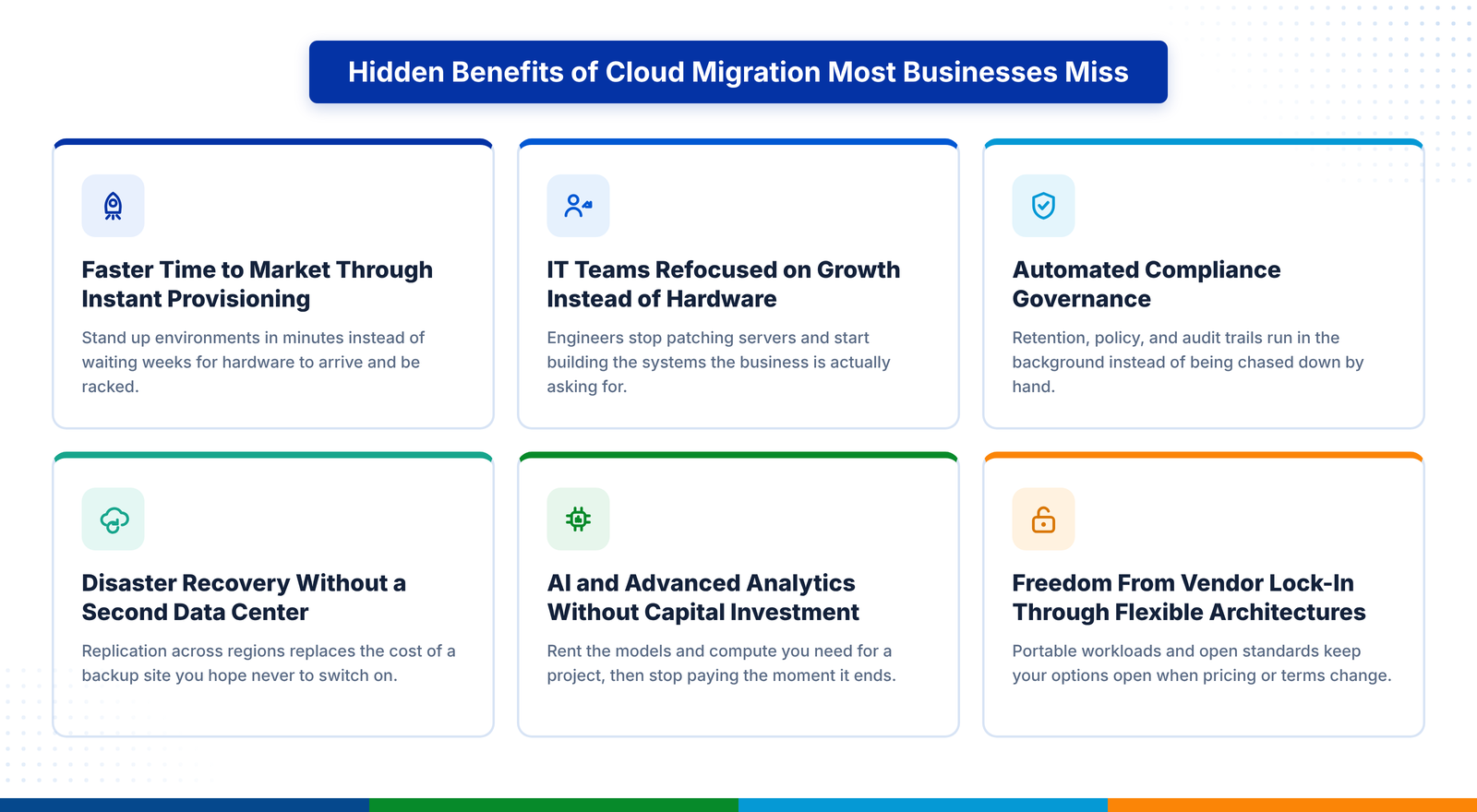
Faster Time to Market Through Instant Provisioning
Cloud provisioning removes much of the waiting associated with hardware procurement and installation. Testing and production environments that once took weeks can often be created in minutes, allowing product releases, client requests, and new initiatives to move at the pace of the idea. Lower-cost experimentation also compounds this speed across projects.
IT Teams Refocused on Growth Instead of Hardware
Cloud adoption changes how internal IT spends its week. Routine server patching, hardware replacement, and portions of platform maintenance shift toward the provider or managed service, allowing internal teams to focus on automation, security, data, and business improvement. Organizations may also reduce pressure to hire scarce infrastructure specialists for shrinking operational workloads.
Automated Compliance Governance
Cloud platforms can automate important parts of governance through encryption, audit logging, access controls, multifactor authentication, policy enforcement, and continuous monitoring aligned to requirements such as GDPR or HIPAA. This does not make compliance automatic, but it helps regulated organizations replace periodic manual checks with more consistent, policy-driven controls and evidence.
Disaster Recovery Without a Second Data Center
Traditional disaster recovery often required a second physical site that many mid-market businesses could not justify, leaving recovery plans limited or untested. Cloud platforms make geo-redundant backup, replication, and automated failover available without building another data center, allowing organizations to design faster recovery targets without equivalent capital investment.
AI and Advanced Analytics Without Capital Investment
Cloud services give teams on-demand access to machine learning, AI, and large-scale analytics without purchasing GPUs or building specialized infrastructure first. The advantage compounds after migration because business data is already closer to the services that can analyze it, turning many analytics and AI initiatives from infrastructure projects into configurable services.
Freedom From Vendor Lock-In Through Flexible Architectures
Hybrid and multi-cloud architectures can improve negotiating flexibility by keeping selected workloads portable rather than tying every system to one provider. That portability can protect long-term plans as pricing, capabilities, or regulations change. Moving workloads is not effortless, but designing for portability gives businesses additional leverage during renewal and architecture decisions.
How Reality Tech Helps You With Cloud Migration?
Reality Tech helps businesses capture both the visible and hidden benefits of cloud migration by combining phased planning with modernization, governance, recovery, and AI readiness. That approach turns faster delivery, refocused IT, automated governance, resilient recovery, and AI access into practical gains rather than assumptions.
As a Microsoft Solutions Partner with more than a decade of experience, Reality Tech delivers SharePoint migration services and Microsoft 365 solutions for regulated industries, supporting planning, migration, validation, training, and ongoing support. Schedule a free consultation to build a phased migration approach aligned with your business, security, and compliance requirements.
FAQs on the Benefits of Cloud Migration
Yes. Many legacy applications can be rehosted or replatformed without a complete rebuild, depending on their architecture, dependencies, licensing, security requirements, and compatibility. An assessment should determine whether migration, modernization, replacement, or retirement offers the strongest long-term business value.
Reality Tech supports cloud migration through assessment, planning, architecture, migration execution, testing, validation, training, and post-migration optimization. Its Microsoft-focused services cover SharePoint Online, Microsoft 365, modernization, governance, security, and automation aligned with each organization’s operational and compliance requirements.
Staying on premises too long can increase hardware refresh costs, maintenance effort, security exposure, recovery complexity, and dependence on aging platforms or scarce skills. It can also delay access to cloud automation, analytics, and AI capabilities.
Have a question?
We’re here to help. Get in touch with us anytime, 24/7